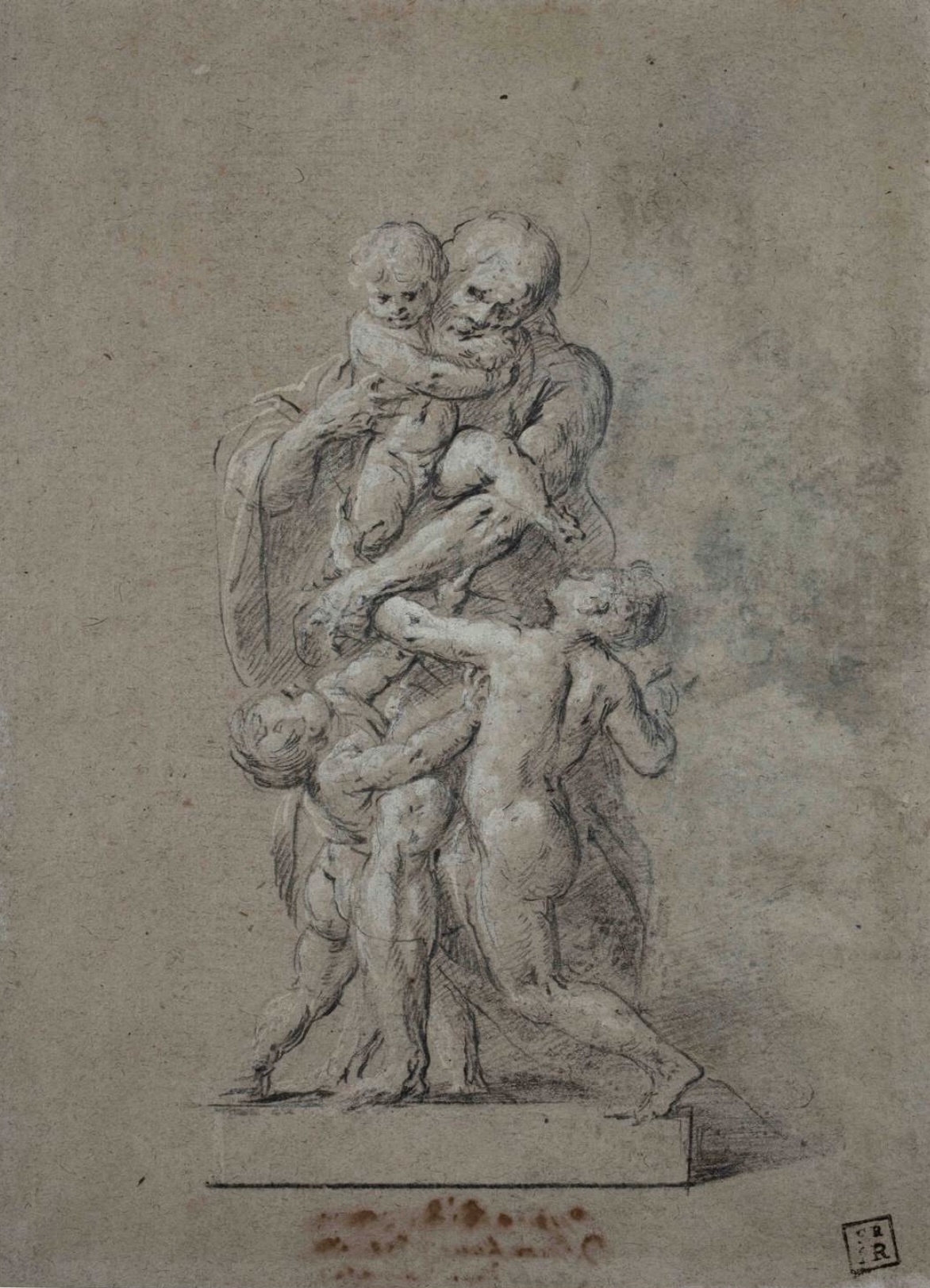
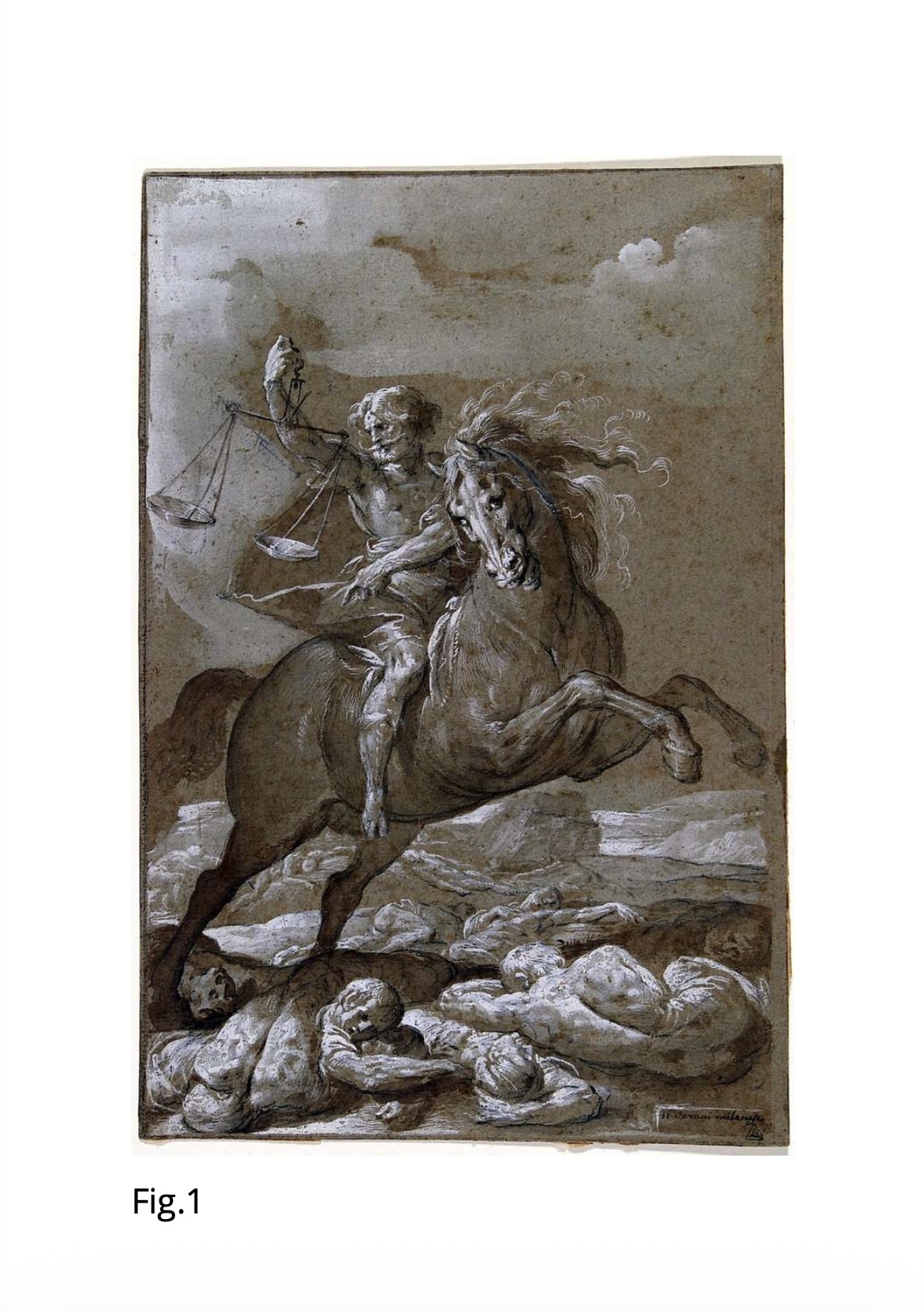
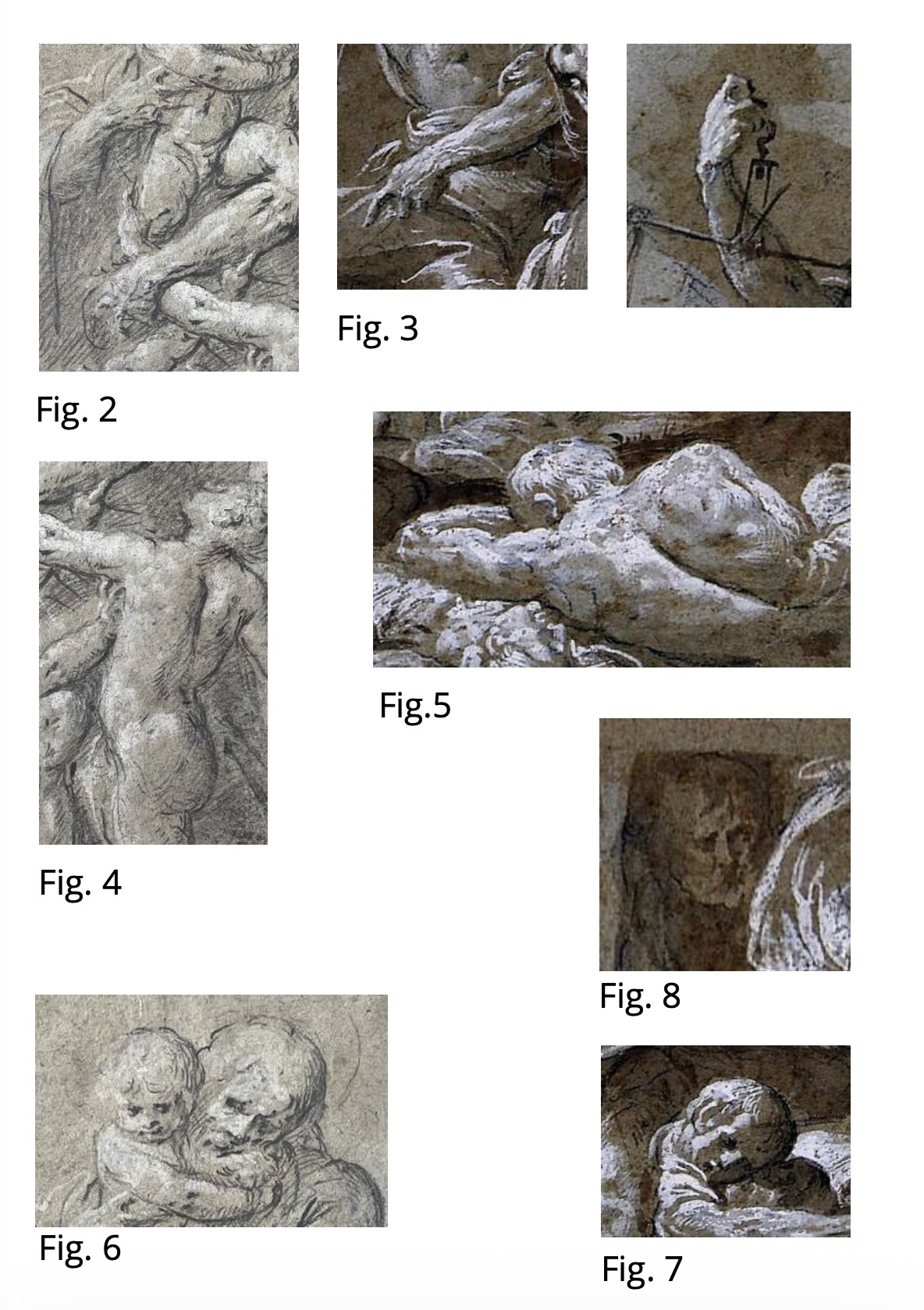
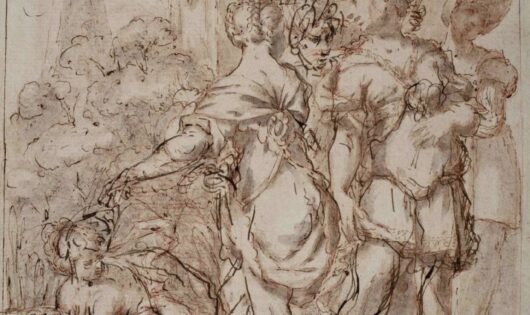
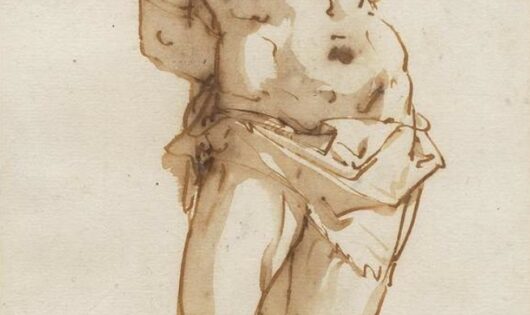
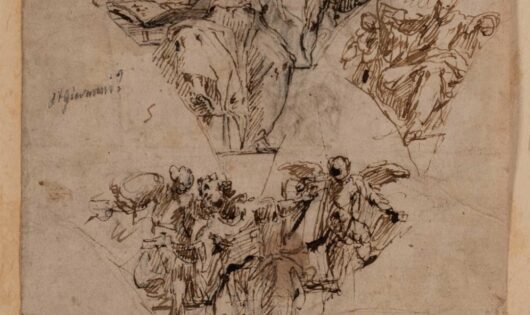
The subject of this refined drawing, which features formal characteristics that can be traced back to the Lombard artistic circle at the turn of the 16th and 17th centuries, remains not entirely clear. While the figure of the haloed old man holding a child immediately recalls Saint Joseph carrying the infant Jesus, it is far more difficult to hypothesize the identities of the two children at their feet; these figures seem almost to be reaching for the infant, who is vigorously protected by the adult. The figure of Joseph as the guardian of Jesus is certainly a theme dear to the Counter-Reformation. However, in the absence of conclusive evidence, one must remain within the realm of hypothesis.As for the purpose of the drawing, judging by the compositional structure and the presence of what appears in all respects to be a pedestal, we can state with a certain degree of confidence that this is a sketch for a sculptural group. In view of the stylistic characteristics and the high level of execution, the sheet can be attributed to Giovanni Battista Crespi, known as il Cerano. Although the artist's graphic corpus remains relatively small today and, in some respects, not entirely homogenous in terms of form, it nevertheless presents several clear examples from an attributional standpoint. These include The Third Horseman of the Apocalypse (2) (fig. 1)—held in the Fondo Osio at the Istituto Nazionale per la Grafica in Rome—which, in our opinion, bears very strong executional similarities to the drawing presented here. Although the Roman sheet was executed not only with black chalk and white lead but also with the use of brown ink wash, the same draftsmanship can bè discerned, providing the opportunity for several interesting comparisons. If one compares Joseph's arms with those of the horseman (figs. 2-3), it becomes evident that they are executed in an almost mirror-like fashion from a stylistic point of view. Without being distracted by the nearly identical position of their respective left limbs, one notices how they express the same lean, nervous, and at times knotty anatomy. Furthermore, the hands are conceived in the same manner: skeletal and claw-like. They are traced with refined, short, sharp strokes, with the white heightening serving to highlight veins and tendons. Moreover, on the lower part of the sheet from the Osio collection, Cerano renders a series of huddled bodies, working them meticulously with brush and white heightening. Indeed, the very same way of conceiving and rendering muscular masses can be found in our sheet as well. This is clearly visible on the back of the child positioned on the right (figs. 4-5). Finally, it should be emphasized that the shapes of the heads of the Infant Jesus and Joseph are conceived with the same volumetric accentuation and roundness as the heads of the recumbent figures in the Roman sheet (figs. 6-7 and 8); they also present a thoroughly comparable somatic type. These characteristics are found, among other things, in many paintings by the artist, making them in fact among the most distinctive morphological traits of his figurative language. Returning to the purpose of this work—namely, to serve as a model for a sculptural group—it is important to remember that Cerano was by no means a stranger to this type of task. Throughout his entire career, he had both practiced sculptural modeling and executed designs to be entrusted to colleagues who would then translate them into stucco or marble. There are several well-documented examples of this activity.Among these, we can particularly recall the cartoon with the Conversion of Saint Paul, later sculpted in marble by Gaspare Vismara, and the series of canvases with the Creation of Eve, Solomon and the Queen of Sheba, Sisera and Jael, Judith and Holofernes, and Esther and Ahasuerus, which were subsequently executed by Vismara, Giovan Pietro Lasagna, and Gian Andrea Biffi. Furthermore, in 1629, he was elected master builder (capomastro) of the Veneranda Fabbrica del Duomo, with the task of supervising the statuary decoration.
Notes
Show/Hide
(1) Renowned Florentine collector and art historian. In light of modern studies on the French sculptor, the attribution proposed by Gabburri can no longer be accepted.
(2) Rome, Istituto Nazionale per la Grafica, Gabinetto Disegni e Stampe, Fondo Osio, folder 10, inventory number: D-FN14444, black chalk, pen, brown ink wash, white lead (?), 265 x 176 mm. The drawing appeared on the market at a Sotheby’s auction in London in 1978. As far as I am aware, it was then published for the first time by G. Bora in Pavia Museo Malaspina, Pavia, pp. 178-179, who linked it to a small oil on panel of similar dimensions held precisely in the Pavia collection. It was indeed the discovery of this drawing that allowed the authorship of the small panel to be assigned to Cerano.
Literature
Show/Hide
G. Bora in Pavia Museo Malaspina, Pavia, Municipality of Pavia, 1981, pagg. 178-179.
M. Rosci, Il Cerano, Electa, Milan 2001.
Il Cerano, 1573 – 1632, Protagonist of Seventeenth-Century Lombardy, exhibition catalogue (Milan, Palazzo Reale 24 February – 5 June 2005) edited by M. Rosci, Federico Motta Editore, Milan 2005.
G. Bora, in The Artist and His Atelier, the Drawings from the Osio Acquisition at the National Institute for Graphics, edited by G. Fusconi, Palombi Editori, Rome 2006, cat. 14, pagg. 76-77.