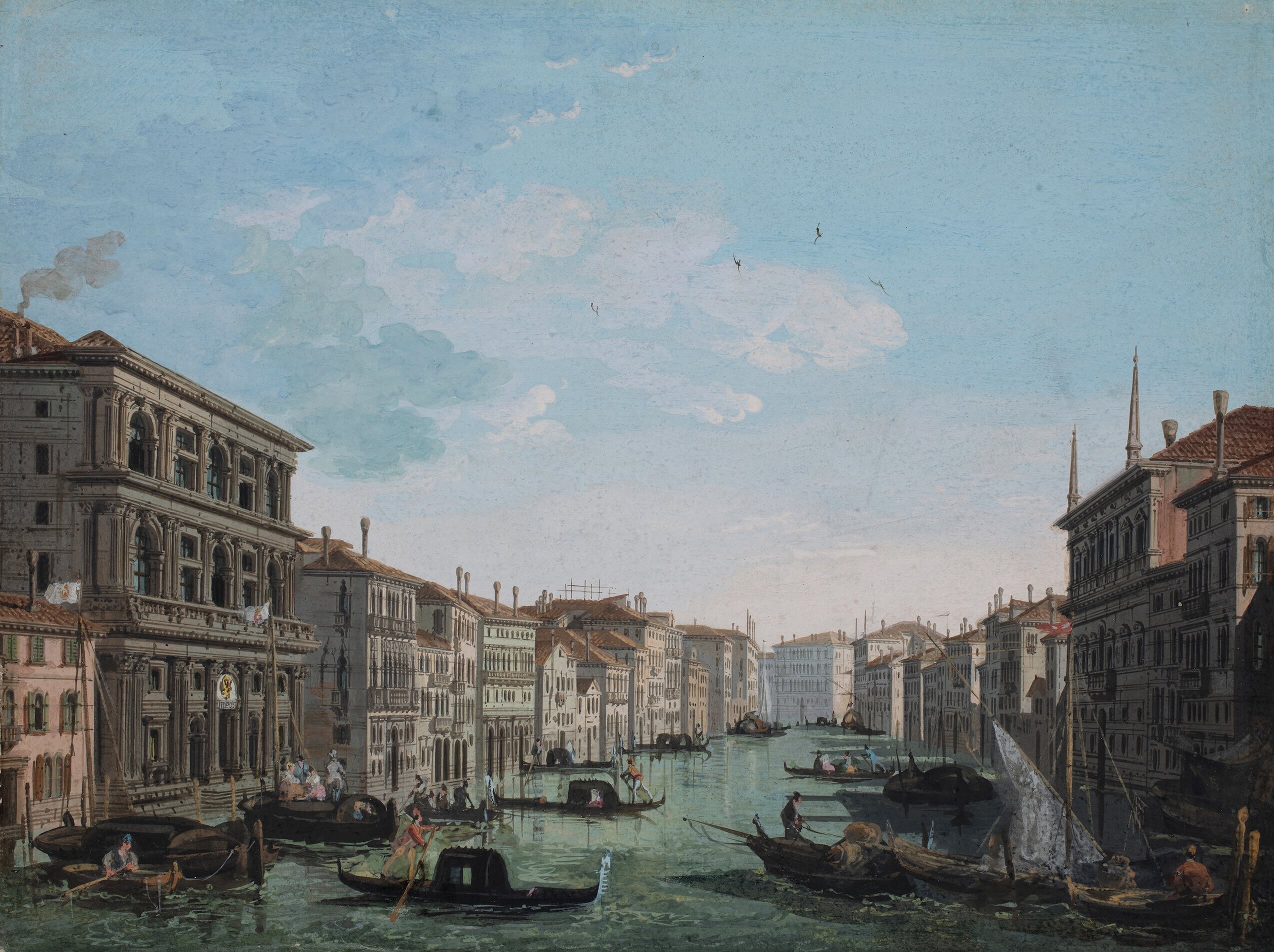
View of the Grand Canal with Palazzo Grimani
Giuseppe Bernardino Bison
(Palmanova 1762 – Milan 1844)
- Gouache
- 144 mm x 193 mm
(Palmanova 1762 – Milan 1844)
Following an initial stay in Brescia, the artist settled in Venice, where he soon gained access to the city’s aristocratic circles. He attended the Accademia and came into contact with some of the leading figures of the Venetian artistic scene, including Pietro Longhi, Alessandro Longhi, Francesco Guardi, the Tiepolos, and the landscape painters Giuseppe Zais and Francesco Zuccarelli.
He later spent some time in Trieste, where he received prestigious commissions. His reputation was established primarily through his Venetian vedute, often small in format but distinguished by exceptional painterly refinement and a clear debt to the tradition of Canaletto. The gouache examined here, published by G. Pavanello (1), represents a significant example of this production: its perspectival construction retains the clarity and precision of eighteenth-century models and remains firmly rooted in the Venetian tradition of view painting.
(1) G. Pavanello, A. Craievich, D. D’Anza, Giuseppe Bernardo Bison, Trieste 2012, cat. 48, p. 208.
G. Bergamini, E. Magani, G. Pavanello, Giuseppe Bernardino Bison Pittore e Disegnatore, exhibition catalogue, Milan 1997.
E. Magani, Giuseppe Bernardino Bison, Milan, 1993.