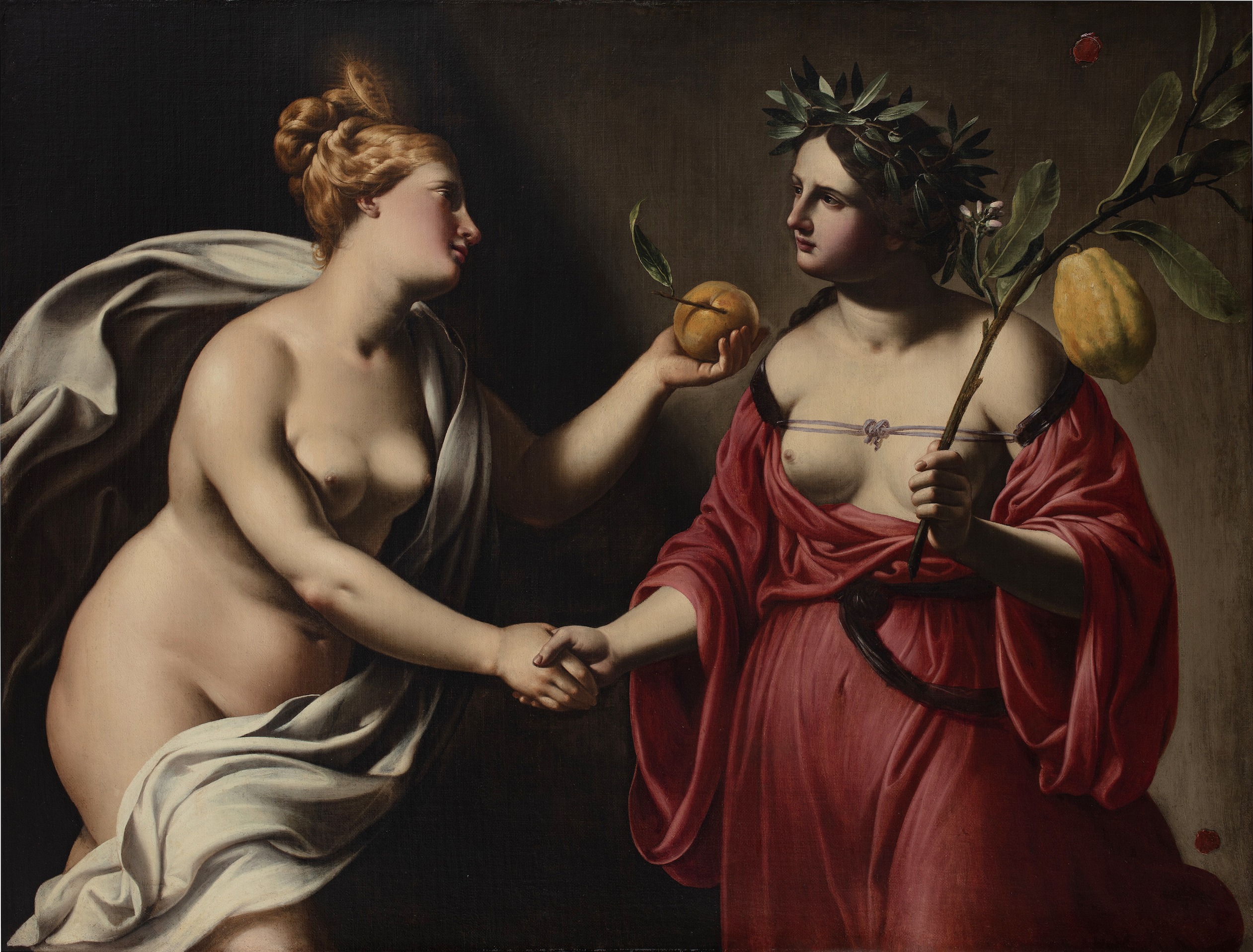
Allegory of Truth and Mercy
Imperiale Gramatica
(Rome 1599 – 1634)
- Oil on canvas
- 103 cm x 136 cm
(Rome 1599 – 1634)
Following a series of critical reassessments, the painting is now attributed to Imperiale Gramatica, son of the renowed Antiveduto. While biographical information on Imperiale remains scarce, his father’s career is considerably better documented. Born into a noble Sienese family, Antiveduto moved to Rome at an early age, where he established a workshop in which the young Caravaggio also worked between 1588 and 1589.
The painting’s recent history can be traced back to its appearance at the Semenzato auction in 1985, where it was attributed to Giacinto Gimignani (1). The following year, it was published in the Stanza del Borgo catalogue as an autograph work by Antiveduto Gramatica under the title Allegory of Summer and Autumn. On that occasion, the canvas was dated to the 1620s, a period corresponding to the artist’s full maturity (2).
In 1990, on the occasion of an exhibition at Galleria Voena, the work was once again attributed to Gramatica senior, although under the title Allegory of Truth and Mercy. Comparisons were drawn between the female faces in the painting and those of other figures by the artist, including the celebrated Judith in Stockholm (3). The revised iconographic interpretation derives from a passage in Psalm 85:
“Mercy and truth are met together; righteousness and peace have kissed each other.”
This interpretation is further supported by the close correspondence between the figure of Mercy and the allegorical description codified by Cesare Ripa in his Iconologia (4).
The biblical passage also suggests that the painting may originally have had a pendant depicting the Allegory of Justice and Peace. This possibility is further supported by the 1635 inventory of the Savoy Collections, which records a “mediocre” painting attributed to Antiveduto Gramatica depicting that very subject (5).
The painting was definitively attributed to Imperiale Gramatica by Gianni Papi (6). In his monograph on Antiveduto, Papi identifies close stylistic affinities between the present work and the Albano Altarpiece, a securely attributed work by Imperiale (7).
While acknowledging the high quality of the painting, Papi also points to several stylistic features characteristic of the younger Gramatica: the treatment of the hands, comparable to those in the Marseille Saint Elizabeth (8); the characteristic golden highlights in the hair, also found in the Veronica at Galleria Laurina (9); and a degree of hesitation in the handling of space, reflecting a hand less assured than his father’s.
(1) Semenzato Auction, Asta di importanti dipinti antichi, 15 December 1985 (as Giacinto Gimignani).
(2) Stanza del Borgo, Disegni e dipinti di antichi maestri dal XV al XIX secolo, Milan 1986, entry 2, p. 80 (as Antiveduto Gramatica)
(3) A. Cottino, M. Voena, Dipinti italiani 1460-1760, Turin March-April 1990 (as Antiveduto Gramatica)
(4) C. Ripa, Iconologia, Padova 1618, reprinted Turin 1986, vol. II, pp. 51-53.
(5) A. Vesme, L’arte in Piemonte dal XVI al XVIII secolo, vol. II, Turin 1966, p. 537
(6) G. Papi, Antiveduto Gramatica, Soncino 1995, entry 97, p. 133, pl. XXXVI, p. 78.
(7) Ibidem, entry 82, p. 127, fig. 55, p. 187.
(8) Ibidem, entry 88, p. 129, fig. 61, p. 190.
(9) Ibidem, entry 92, p. 131, fig. 63, p. 192.