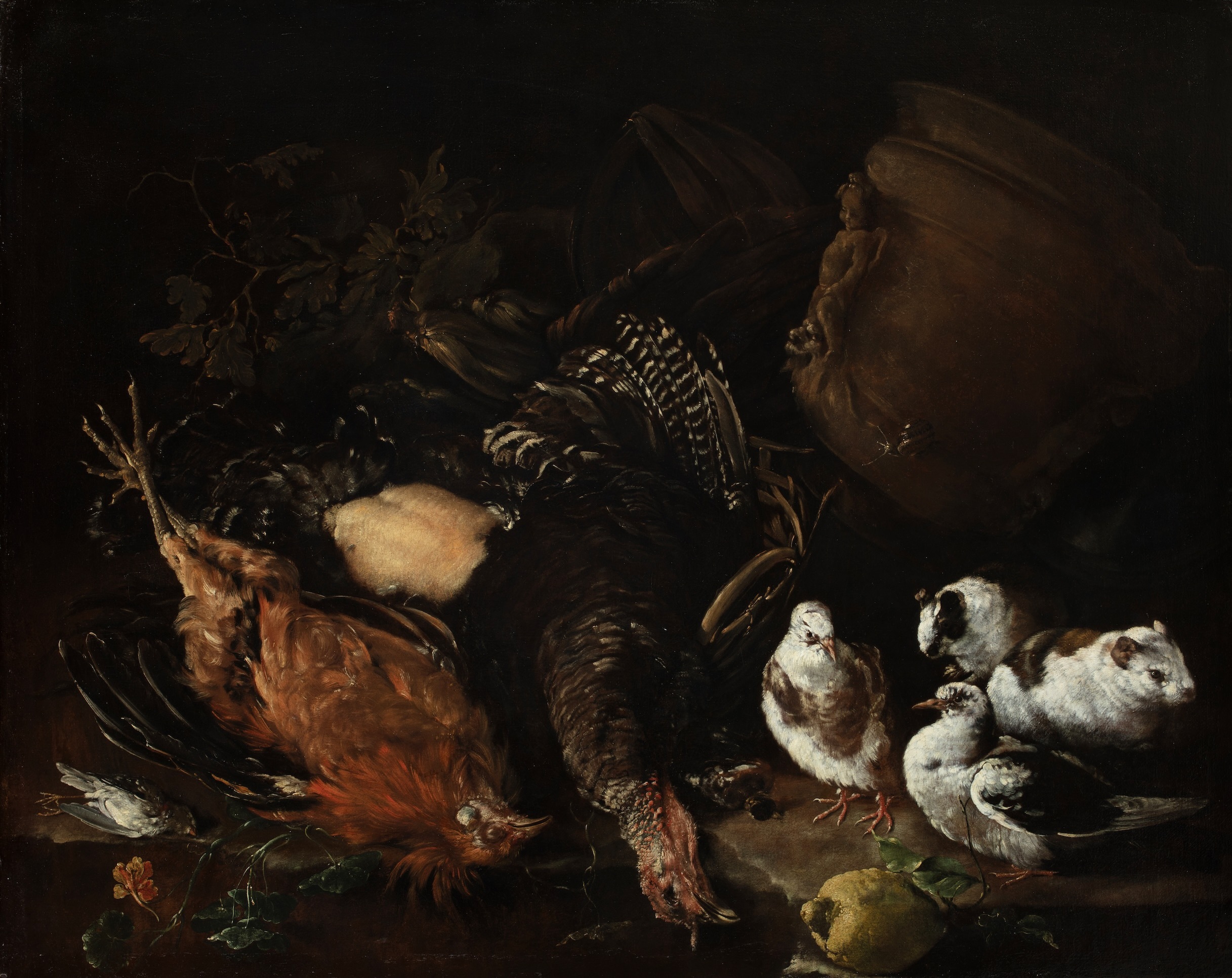
Still Life with Farmyard Animals, Guinea Pigs, and Pigeons
Domenico Guidobono
(Savona 1668 – Naples 1746)
- Oil on canvas
- 96 cm x 121 cm
(Savona 1668 – Naples 1746)
The painting has a particularly complex attributional history. Formerly in the collection of Prince Argoutinsky until 1941, it was exhibited at the 1929 Brussels Exhibition as a work by Christoffel Puytlinck, on the basis of its compositional structure and Northern character, both of which closely evoke the Flemish tradition (1). In 1984, it reappeared on the art market at Finarte under an attribution to Anton Maria Vassallo, thereby placing it within the context of Genoese still-life painting (2). Subsequently, while the whereabouts of the work remained unknown, Anna Orlando proposed the correct attribution to Domenico Guidobono in a chapter of Mary Newcome’s monograph on the artist, developing an attribution she had already advanced in her earlier studies (3). Nevertheless, in 2025 the painting appeared at auction at Dorotheum under the earlier attribution to Puytlinck, and in 2026 at Lucas in Milan as a work by Franz Werner Tamm (4). The painting should ultimately be attributed to Domenico Guidobono, although the subject is relatively rare within his oeuvre, a circumstance that likely contributed to the repeated changes in attribution.
(1) E. Zarnowska, La nature-morte Hollandaise. Les principaux représentants, ses origines, son influence, exhibition catalogue, Bruxelles 1929, p. 23, cat. no. 78, pl. 52.
(2) Finarte, Rome, 20 November 1984, Dipinti antichi dal XV al XVIII secolo, lot 133.
(3) M. Newcome Schleier, Bartolomeo e Domenico Guidobono, Turin 2002, p. 141, NM14. A. Orlando, Le ‘nature morte animate’ del Seicento Genovese, in Fasto e rigore. La natura morta nell’Italia Settentrionale dal XVI al XVIII secolo, exhibition catalogue edited by G. Godi, Milan 2000, pp. 13-25.
(4) Dorotheum, Vienna, 25 June 2025, lot 101 (as Christoffel Puytlinck). Lucas, Milan, 17 February 2026, lot 96 (as Franz Werner Tamm).
A. Orlando 2000, p. 21, fig. 13.