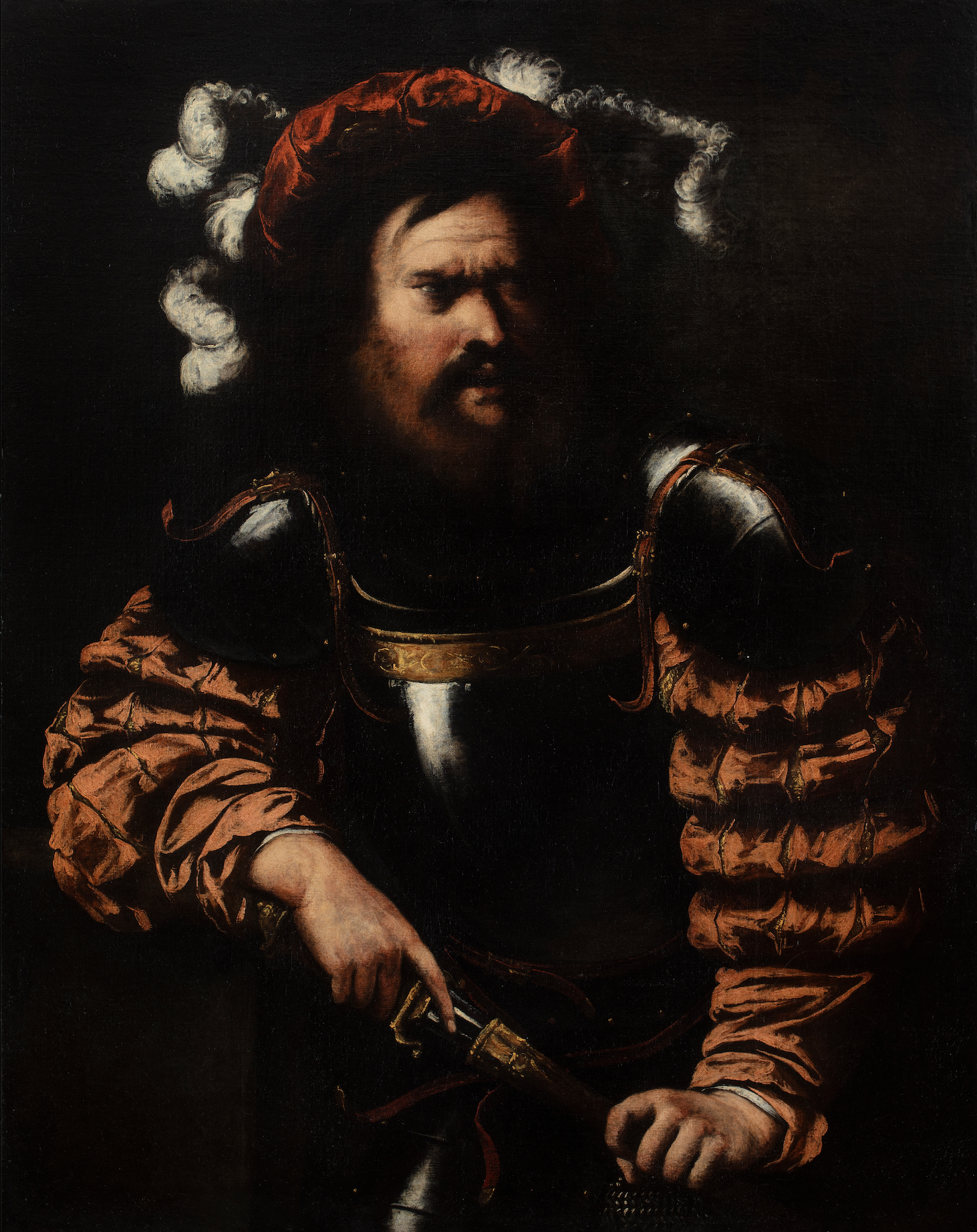
Figure of a Warrior Drawing His Sword
Pietro Della Vecchia
(Venice 1603 – Vicenza 1678)
- c. 1650
- Oil on canvas
- 118 cm x 92 cm
(Venice 1603 – Vicenza 1678)
Regarding Pietro della Vecchia’s The Bravo, formerly in the Scarpitti collection, on which an opinion was requested, it is necessary to begin by reconsidering the words of the brief appraisal written in 1939 by Adolfo Venturi, the founding father of modern Italian art history. It is worth quoting, as it now constitutes an important historical document that adds to the intrinsic value of the work itself (1).
Venturi, too, is clearly carried away by an enthusiasm for the painting’s quality, one that appears unmistakably sincere, at a time when twentieth-century scholarship on the artist was sparse and far from settled, regarding the image as “among the most brilliant pictorial compositions by Pietro Della Vecchia… a swaggering figure of a man-at-arms, or rather a seventeenth-century bravaccio, captured in the act of unsheathing his sword with a fierce frown.” Particularly apt is the adjective “brilliant” (squillante), clearly alluding to the colours: sombre yet animated by sharp contrasts, refusing to dissolve into soft transitions, instead ringing out like vivid, high-pitched tones, cheerful notes alive with an engaging festivity. That the figure is also swaggering (spavalda) is a quality at once evident and provocative, immediately signaling its expressive force: “Caravaggesque shadows heighten the clamor of the lights bursting from the baroque cartouches of the satin sleeves and the feathered cap. As always in the oeuvre of this vivid painter, the Giorgionesque tradition yields to the influence of Caravaggio: in the whimsical splendor of the figure and the shimmering brilliance of his costume, one recognizes the legacy of the capricious Romanino”. Here, however, we can no longer entirely agree. Adolfo Venturi, mentor to Longhi, was already inclined to see the influence of Caravaggio everywhere; yet here, the handling of light remains that of Giorgione, of the late Titian, and of Titian’s followers, expressed in all the splendour of pittura di tocco (broad, tactile brushwork).
Pietro Della Vecchia and Caravaggio both draw upon Giorgione, a shared root that binds them, yet they pursue divergent paths. The Venetian painter’s treatment of light remains distinctly Venetian, as does his fondness for sumptuous textiles, so characteristic of the Veneto tradition. The reference to Romanino is highly perceptive; yet while the portraits by the Brescian master and his contemporaries, noble and picturesque as they are, remain poised in restrained composure and dignified silence, Della Vecchia’s bravo strides across the stage, unsheathes his sword, and sets a dramatic acion in motion. His face is anything but impassive, contorted in a menacing grimace: we are confronted with a figure straight out of Baroque theater, tending almost more towards the comic than the tragic.
In the seventeenth century, an age marked by assaults and unpunished crimes, this archetype, far from being merely familiar, became exceptionally popular. Highly sought after by patrons, the painter replicated the figure of the bravo on numerous occasions, dressed in black with a feathered hat whose plumes fold forward, unsheathing his sword in line with his accommodating commercial sensibility.
Yet over time, these depictions grew increasingly summary and repetitive. In such cases, one would also have to consider the hypothesis of seventeenth- and eighteenth-century copies: genuine fakes of the "forger" himself. The painting from the Scarpitti collection in Rome, by contrast, displays splendid impasto and state of preservation, easily distinguishing it as a benchmark within this later over-replicated group of variants. Indeed, a sequence of versions presumed to be autograph by Pietro della Vecchia comes to mind: Milan, De Pisis collection; Salzburg, Residenzgalerie, boasting the prestigious Czernin provenance; Prague, Národní Galerie; Turin, private collection (2).
Another closely related composition, in which the cuirass is absent or barely discernible, generated an even larger series of variants, all likewise presumed to be autograph: Vienna, Kunsthistorisches Museum, from the collection of Archduke Leopold Wilhelm; Dresden, Gemäldegalerie; Genoa, Palazzo Spinola; Rome, Palazzo del Quirinale; Turin, private collection; Paris, Louvre; New York, Shickman Gallery; Prague, Národní Galerie; London, Sotheby’s; Warsaw, Muzeum Narodowe, from the collection of King Stanisław August; Turin, Quaglino collection (3). Aikema also mentions a possible copy of the subject by Luca Giordano, in a private collection in Venice (4).
In 2010, Dal Pozzolo published yet another autograph version of the “Scarpitti” type in a private collection in Padua (unless it is the former De Pisis canvas) (5). Furthermore, a print belonging to this same lineage is known, engraved by Lucas Vorsterman the Younger, which does not appear to match any surviving painted example (6). In all, this accounts for at least fifteen paintings that replicate the composition with varying degrees of fidelity. They bear witness to a popular and commercial fortune perhaps without equal, one by no means simple to unravel, given that the patrons frequently ranked among the most distinguished in Europe. Not only does Pietro Della Vecchia emerge as one of the most sought-after painters of his day, but the motif of the “warrior drawing his sword” stands out as the single most requested subject across his entire catalogue.
(1) Raccolta d’arte adunata dal prof. Giovanni Scarpitti. Illustrata per il Senatore prof. Adolfo V enturi, 1939, p.110.
(2) B. Aikema, Pietro della V ecchia and the heritage of the Renaissance V enice, Florence 1990. Aikema groups the series under the heading: “warrior wearing a cuirass, drawing his sword” (p.149).
(3) Under the heading: “warrior drawing his sword”. Aikema, op. cit., pp. 149-150.
(4) Aikema, op. cit., Ibidem.
(5) Dal Pozzolo, Il fantasma di Giorgione, Treviso 2011, pp. 54-55.
(6) Dal Pozzolo, op. cit., Ibidem.