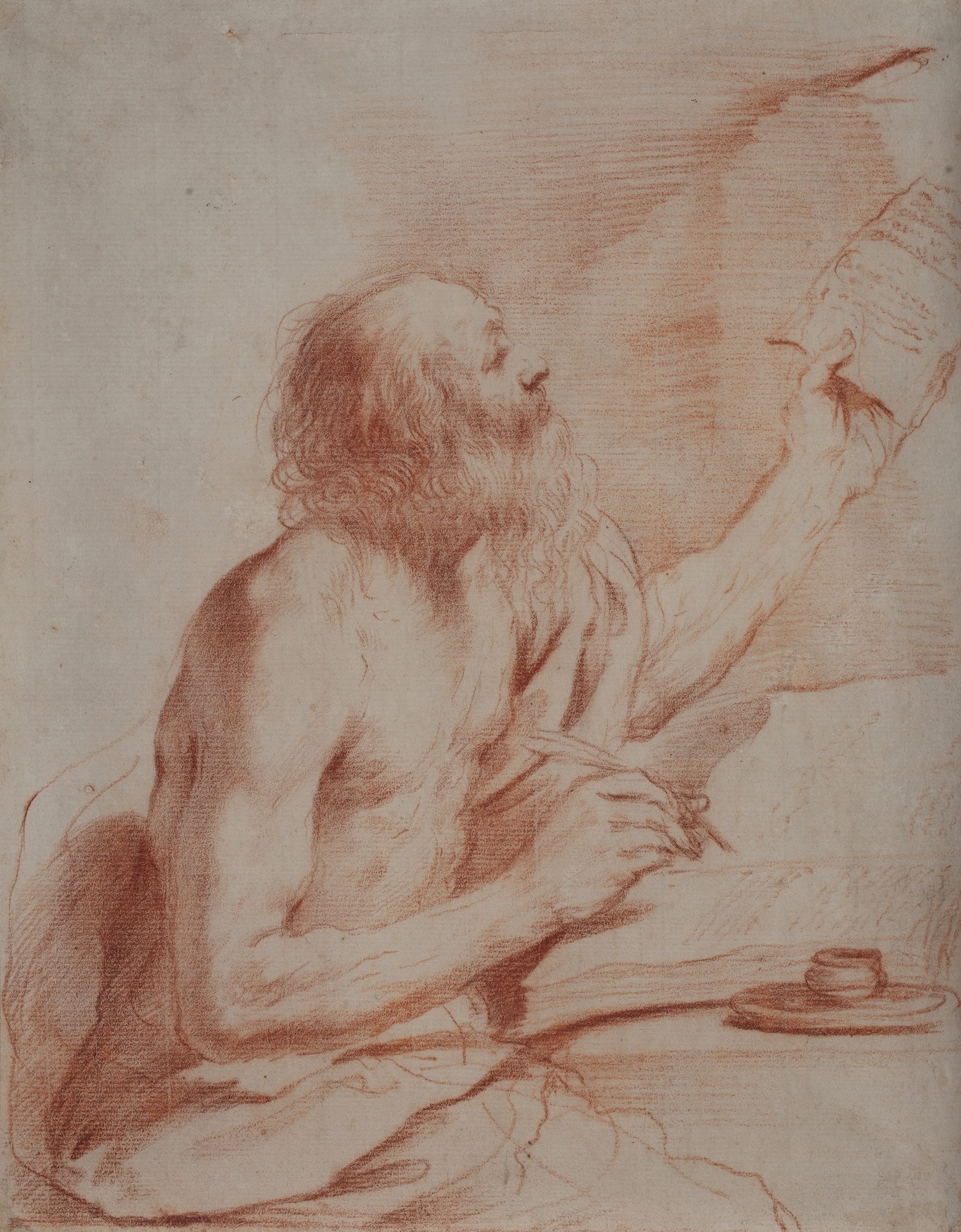
Saint Jerome Writing
Giovanni Francesco Barbieri detto il Guercino
(Cento 1591 – Bologna 1666)
- 1632-1638 ca.
- Red chalk on laid paper
- 285 mm x 220 mm
(Cento 1591 – Bologna 1666)
Replete with virtuosic passages in red chalk defining aging skin, flowing hair, and light reflecting off of drapery, this beautifully preserved sheet by the mature Guercino displays an unusual composition representing a semi-nude Saint Jerome in a landscape. Seated before a table with a large book and a simple inkwell, Jerome lifts the quill in his right hand, pausing his writing to consult one of the biblical texts he is translating into Latin for the Biblia vulgata. Farsighted, he holds up the page with his dramatically extended left arm toward the top right of the composition in order to read. This wonderfully human gesture animates the scene, creating a dynamic diagonal that originates in the lower left corner. What may have begun as a bit of naturalism has had a secondary effect: the gaze upwards and the elevation of the sheet instill a sense of reverance and inspiration.
When this soulful drawing was with the Stanza del Borgo gallery in 1988, Sir Denis Mahon, who accepted it as autograph, dated the sheet to around 1632 (1). This seems entirely plausible, though I believe the range could easily be extended a few years, given the existence of similar works datable to as late as c. 1638. Somewhat less finished than the present sheet, the latter possibly made as an independent work of art, is a red chalk preparatory study in the Royal Library at Windsor of a Youth with his Arms Outstretched to the Right (Fig. 1), made for Guercino’s untraced canvas of Apollo Flaying Marsyas of 1637. The latter’s composition, showing two half-length figures, is known through what is probably a painted copy (2).
Of nearly the same moment is a red chalk study formerly in the collection of Duke Roberto Ferretti di Castelferretto (Fig. 2), for the figure of Saint Paul the Hermit in Guercino’s famous altarpiece in the church of Sant’Agostino, Rome, of Saint Augustine, Saint John the Baptist, and Saint Paul the Hermit. (3). Payments for this work stretched out from 2 January 1637 to 7 May 1638. Though not nearly as finished or as robust a drawing as the present work, the Paul the Hermit study, interestingly, has a similar approach to the treatment of the torso, the head (also looking up), and the drapery, which also creates brilliant passages by using the reserves of the white paper.
(1) Bareggi 1988, p. 26: “Sir Denis Mahon data il disegno dopo il periodo romano dell’artista, al 1632 ca.”
(2) For the drawing (265 x 207 mm; inv. 2842) and the related commission, see Nicholas Turner and Carol Plazzotta, Drawings by Guercino from British Collections, exh. cat., British Museum, London, 1991, p. 142, no. 116; and Nicholas Turner, The Paintings of Guercino. A Revised and Expanded Catalogue Raisonné, Rome: Ugo Bozzi, 2017, p. 524, no. 234.
(3) 3Sold Christie’s, London, 2 July 1996, lot 130, where acquired by Jeffrey E. Horvitz; his sale Sotheby’s, New York, 23 January 2008, lot 53; and Sotheby’s, New York, 28 January 2015, lot 61. The online text for the 2015 sale states that the attribution of the sheet and its connection to the S. Agostino altarpiece were made by Sir Denis Mahon.
Antichi disegni dal XVI al XIX secolo, Stanza del Borgo, sale cat., Milan, 1988, p. 26, ill. p. 27.