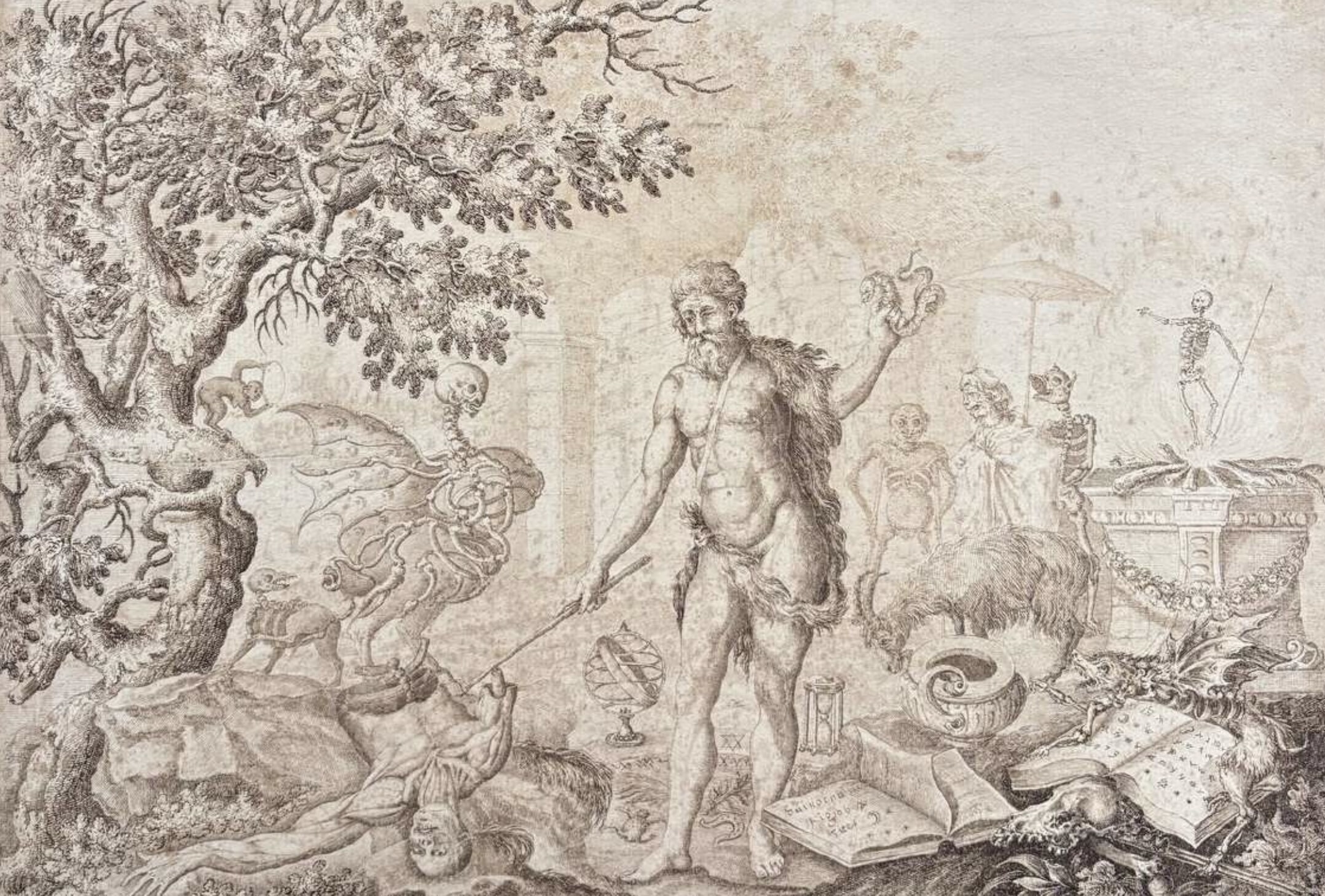
Vanitas Scientiarium
Antonio Borgia
(17th century)
- Pen and brown ink
- 300 x 437 mm
- Laid down on three corners on an old mount
(17th century)
No information is available on Antonio Borgia; the uniqueness of the subject suggests that he was an "amateur, "passionate about alchemical sciences. The bizarre character of the work is evident from the artist's signature on the book in the foreground. It reads “Suinotna Aigrob Ticef,” which corresponds to the mirror reading of “Antonius Borgia Fecit.” Esoteric books, indecipherable symbols, monsters, and skeletons animate this extraordinary seventeenth-century invention. This iconographic repertoire recalls hermetic culture and the allegories of the Vanitas, where all earthly knowledge is destined to confront Time and Death. On a tree, a monkey holds a mirror while the bark below takes on the appearance of a bird. One of the most intriguing details is the book with pseudo-magical characters: it appears to imitate cabbalistic, alchemical, or astrological alphabets. These are likely not decipherable signs, but rather an iconographic device to evoke occult knowledge. In the centre, on the ground, graphic symbols appear that refer to the four elements, including the hexagram and the symbol for water. As for the central male figure, it is possible to trace the reference model: Borgia in fact copies the pose of Apollo from Melchior Meier's engraving (1) depicting Apollo Flaying Marsyas (c. 1580), altering only the objects held in his hands. The upside-down bust also follows the model of the tortured Marsyas, although it reproduces only the upper half of the body.
(1) Hollstein’s, German engravings…, vol. XXV, Roosendaal, 1989, pag. 28, n. 7.